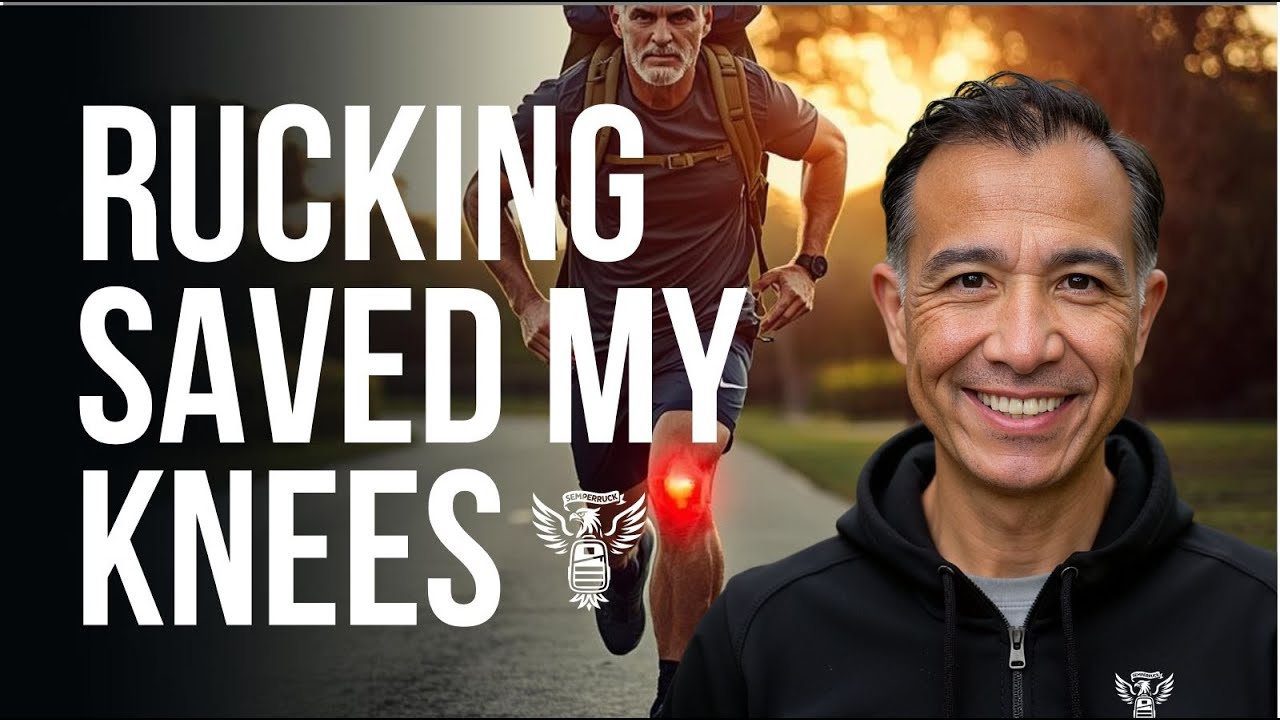
Rucking Saved My Knees at 50: How Smart Loaded Training Rebuilt What Running Damaged
▶ Watch on YouTube: Rucking Saved My Knees at 50. Here's How I Actually Did It.
At 50, my knees were sending me a message I didn't want to hear. The kind of message that arrives not dramatically, not all at once, but incrementally - a stiffness on the stairs in the morning, a ache that appeared after runs and stayed longer than it used to, a particular protest when I sat in a car for more than an hour. Years of high-impact activity, Marine Corps service with its mandatory formations and loaded marches, and the general accumulated tax of a life lived hard had deposited themselves in my joints with compound interest.
I was not going to accept that as my trajectory. Not at 50. Not at 55. Not at any age.
But I also wasn't going to pretend the signals weren't there and just hammer through them. I've watched that play out for enough people in enough variations to know how it ends. Grinding on damaged joints with the same training that damaged them isn't toughness. It's the absence of adaptation - the same input expecting a different output.
What I did instead was rebuild my training from the joints up. I stopped asking my knees to absorb the impact of running and started asking them to respond to the controlled load of rucking. I went back to the principle that made Marine training work: structured, progressive loaded movement at disciplined intensities, with intent behind every session.
The result was not what I expected in scope or speed. Rucking rebuilt my knee health in a way that three different approaches to conventional treatment hadn't touched. Training Day 505 - a 3.3-mile interval ruck, 35-pound load, zone 2 baseline with zone 3 pushes during double-time segments - was one of the data points that confirmed it. This post is the full story: the science behind why it works, the specific training approach I used, and the complete framework for anyone over 40 dealing with knee issues who wants to keep training hard for the long term.
The Science: Why Rucking Is Kinder to Your Knees Than Running
The counterintuitive thing about rucking and knee pain is this: you're adding 35 to 55 pounds to your body, and somehow that's better for your knees than running without any extra load. That sounds wrong. It requires explanation.
The explanation is impact forces.
Running generates ground reaction forces - the force your joints absorb with each footfall - of approximately 2.5 to 3 times your body weight with every stride. On a 5-mile run at 8-minute pace, that's approximately 6,000 to 7,000 strides, each one delivering 2.5 to 3 times your body weight into your joints. For a 180-pound person, that's 450 to 540 pounds of force per step, tens of thousands of times per run.
Rucking - loaded walking - generates ground reaction forces of approximately 1 to 1.5 times body weight. Even with 35 extra pounds added, you're dealing with forces of 1.5 to 2 times body weight per step, delivered at a much lower cadence. The difference per step is significant. Multiplied over thousands of steps, the cumulative joint loading is dramatically lower.
This is why many people with knee pain that prevents running can ruck without pain - or can build up to it with appropriate load progression. The mechanical stress profile is fundamentally different.
But the knee health benefit of rucking goes beyond just reducing impact. The second mechanism is muscular support development.
The knee joint itself is relatively passive - it's primarily held in place and guided through its range of motion by the muscles surrounding it: the quadriceps, hamstrings, glutes, hip abductors, and the fascial system connecting them. When these muscles are strong, coordinated, and well-developed, they absorb and distribute forces that would otherwise concentrate in the joint itself. When they're weak or poorly coordinated, the joint absorbs what the muscles can't.
Rucking under load systematically develops all of these muscles in exactly the pattern the knee needs for support. The weighted, bipedal walking motion activates the glutes and hip stabilizers in a way that many gym exercises don't replicate - because it's load distributed over a full movement cycle, not isolated contractions at a machine. The result, over months of consistent training, is a joint that has progressively more muscular support, which means progressively less stress on the passive structures that are most vulnerable to age-related wear.
Research from the National Institute of Arthritis and Musculoskeletal and Skin Diseases supports the role of quadriceps and hip strengthening in reducing knee pain and improving joint function in patients with knee osteoarthritis. [See: https://www.niams.nih.gov/health-topics/knee-problems] The mechanism is the same: more muscular support, less joint stress, better function.
Training Day 505: The Interval Ruck That Proves the Method
I want to take you through Training Day 505 specifically because it illustrates exactly how the training approach works in practice - and because this was one of the high-view sessions that generated the most questions and the most responses from people dealing with their own knee issues.
The parameters: 3.3 miles, 35-pound load, Training Day 505 in my consecutive streak. The structure: zone 2 baseline pace with zone 3 pushes during double-time intervals. Alternating intensity within a controlled overall effort.
The interval structure wasn't random. It was intentional, and for knee health specifically, it's one of the most important elements of the approach.
Here's why intervals matter for knees: constant, monotonous loading at the same pace and intensity creates what biomechanists call repetitive stress accumulation. The same forces hitting the same joint structures at the same angles, over and over, with no variation. Tendons, cartilage, and ligamentous structures are well-designed to handle varied, adaptive loading. They're less well-designed for repetitive identical stress. Intervals - varying pace, cadence, and effort within a session - distribute the mechanical stress more broadly and give connective tissue brief windows of relative rest even within an active session.
The zone 2 baseline segments provide active recovery for the connective tissue while maintaining cardiovascular training. The zone 3 double-time segments provide the muscular strength and cardiovascular capacity stimulus. The alternation between them keeps the session productive without locking the joints into repetitive loading that accumulates into overuse injury.
This was Marine ruck training rebuilt for fitness over 40. The double-time cadence calls of a USMC column march - standard pace, double-time, recover, double-time - weren't designed with modern exercise science in mind. But they embodied a principle that exercise science has since validated: varied intensity within a training session produces superior adaptation with lower overuse injury risk than constant-intensity training.
I brought that principle into civilian training and adapted it specifically for knee-protective loading. Thirty-five pounds - not 55, because load management matters - at intervals that challenge the system without grinding the joints. Zone 2 for base building and joint recovery within the session. Zone 3 for capacity development. The result is a session that delivers real training stimulus while actively managing the mechanical load on vulnerable structures.
The Complete Framework for Smart Rucking Over 40 With Knee Issues
If you're reading this because your knees hurt, or because someone has told you that high-impact fitness is behind you, here is the complete operational framework I'd give you:
Start lighter than you think you need to. Twenty pounds is a real training load. I don't care what your ego says about it. Your ego doesn't have cartilage. Your joints do. Start at 20 pounds and build over weeks and months. The connective tissue adaptation clock runs slower than the muscle adaptation clock by a factor of three to four. Give it time.
Prioritize zone 2 volume. The majority of your rucking - especially in the first six months - should be zone 2. This is where aerobic base builds, where fat oxidation develops, and where the system is working without generating the joint stress that higher-intensity effort does. The foundation comes first.
Use intervals deliberately. Once your body has adapted to a basic rucking load over 6 to 8 weeks, introduce intervals: one to two minutes of elevated pace (double-time), two to three minutes of base pace recovery, repeat. This develops capacity without repetitive stress accumulation. Start with two to three intervals per session. Build to five to eight as fitness and joint tolerance develop.
Optimize your mechanics. Knee pain is often a downstream effect of upstream mechanical problems. Heel-striking, internally rotated femurs, excessive forward lean - all of these change the force path through your knee in ways that amplify stress on vulnerable structures. Focus on midfoot contact rather than heel strike. Drive from the glutes and hips, not just the quads. Keep upright posture with chin up and shoulders back. These mechanical changes redistribute load and reduce knee stress substantially.
Monitor your recovery response. After every session, note how your knees feel 12 to 24 hours later. Mild fatigue is normal. Swelling, sharp pain, or pain that worsens after the session are signals to reduce load and address mechanics before continuing. The adaptation window is months, not days. Be patient with the process.
Add targeted strength work. Two sessions per week of specific hip and glute strengthening - Romanian deadlifts, hip thrusts, lateral band walks, single-leg work - provides the muscular support that rucking develops over time, accelerated. Strong glutes change everything about knee mechanics. This is not optional conditioning. It's therapeutic.
Zone 2 Recovery Rucking: The Low-Impact Secret to Long-Term Fitness Over 40
Why "All-Out" Training Is the Wrong Goal After 50
Here is the shift in thinking that made everything else possible, and I want to state it as clearly as I can because it runs counter to everything that gets rewarded in fitness culture:
I stopped training to prove what I can do today. I started training to maximize what I can do for the next twenty years.
Those are genuinely different goals. They lead to genuinely different training decisions. And for knees specifically, the difference is enormous.
All-out training every session feels like commitment. It looks impressive in a training log. It generates the kind of discomfort that popular fitness culture has taught us to associate with effectiveness. And for knees already carrying twenty-plus years of accumulated wear, it is a reliable pathway to structural damage that reduces your training options permanently.
I've watched hard men - men who were seriously impressive athletes in their 30s and 40s - train their way into bilateral knee replacements in their 50s. Not because they were weak or undisciplined. Because they applied young-body training logic to old-body physiology. Because they never made the shift from training to prove something today to training to remain capable for decades.
That shift requires accepting that some sessions are supposed to feel easy. That recovery is productive. That 35 pounds on a Tuesday is the right call even when 55 pounds is available. That zone 2 is a serious training zone, not a compromise.
The body over 50 is not a lesser version of the body at 30. It's a different operating system that rewards different inputs. The inputs it rewards are progressive loading, zone-aware training, recovery-informed programming, and the patience to build capability across months rather than days. Apply those inputs consistently and the body over 50 can produce fitness that competes with - and often exceeds - the functional capability of people decades younger who are grinding without intelligence.
What Consistent Smart Loading Has Produced: The Actual Results
I want to close with the tangible, measurable outcomes of this approach, because I'm not asking you to take this on faith.
My knees work. Not "work well enough to get through the day" - work. I ruck daily with 35 to 55 pounds. I train interval sessions. I cover 3 to 7 miles per session depending on programming. The morning stiffness that was a daily feature at 50 is gone. The post-activity ache that used to linger for 24 hours after a hard effort has disappeared. I have better functional knee movement today, at 50-plus, than I did at 45.
That's not luck. That's not good genetics. That's the product of a specific training method applied consistently over hundreds of sessions, informed by a clear understanding of what the body over 50 needs to thrive rather than just survive.
The method is available to you. The framework is in this post. The equipment to execute it is simple - a rucksack and a pack plate. The community to support it is real.
Your knees don't need permanent rest. They need structural support, progressive loading, and the intelligence to distinguish between the training that builds them and the training that grinds them down. Rucking delivered all three for me. It can for you.
This is what fifty-plus fitness looks like when you do it right. Start where you are. Build from there. Visit semperruck.com for the gear, the framework, and the community making this possible for people over 40 every day. Your body has more to give. Let's go get it.